

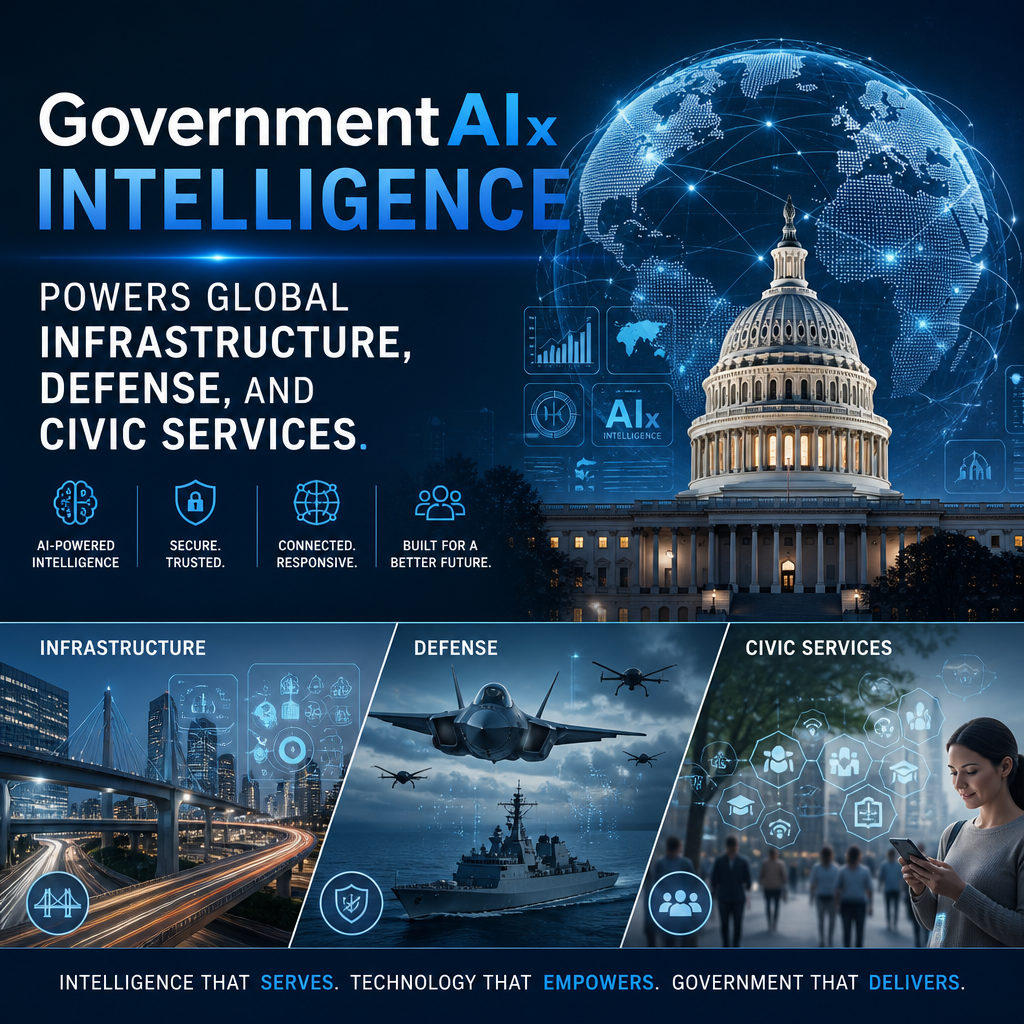
GovernmentAIx Intelligence Powers Global Infrastructure, Defense, and Civic Services
Global Infrastructure, Defense, and Civic Services Powered by GovernmentAIx Intelligence
Governments around the world are entering a new era of public administration. Rapid advances in artificial intelligence are changing how nations manage infrastructure, protect communities, deliver essential services, and respond to emergencies. At the center of this transformation is GovernmentAIx intelligence: the use of advanced, secure, and accountable AI systems to support public-sector decision-making.
From smarter transportation networks to faster disaster response, GovernmentAIx intelligence can help public institutions operate with greater efficiency and foresight. Its impact reaches far beyond technology departments, influencing the daily lives of citizens and the long-term resilience of entire societies.
Modernizing Global Infrastructure
Infrastructure systems are among the most important assets managed by governments. Roads, bridges, energy grids, water networks, airports, and telecommunications systems require continuous investment and maintenance. Traditional methods often rely on scheduled inspections or manual reporting, which can leave officials reacting to problems after they occur.
GovernmentAIx intelligence enables predictive infrastructure management. AI systems can analyze data from sensors, satellites, maintenance records, and connected devices to identify early signs of damage or stress. This allows agencies to prioritize repairs before minor faults become costly failures.
Smarter Transportation Networks
AI-powered transportation systems can improve mobility in both major cities and rural regions. Intelligent traffic platforms can analyze congestion patterns, adjust signal timing, and recommend alternative routes. Public transit agencies can use predictive analytics to improve scheduling, anticipate demand, and reduce delays.
These systems can also strengthen road safety by detecting dangerous intersections, identifying recurring accident patterns, and supporting faster responses to incidents. Over time, data-driven planning can help governments design transportation networks that are more accessible, efficient, and environmentally sustainable.
Resilient Energy and Utility Systems
Energy and water systems are also benefiting from intelligent automation. AI can forecast energy demand, balance renewable power sources, and identify unusual activity that may signal equipment failure or cyberattacks. Water authorities can monitor consumption, detect leaks, and improve distribution during droughts or emergencies.
By combining real-time information with long-term forecasting, GovernmentAIx intelligence helps governments build utility networks capable of adapting to population growth, climate pressures, and unexpected disruptions.
Strengthening National and Community Defense
Defense increasingly depends on information, speed, and coordination. GovernmentAIx intelligence can support national security agencies by processing large volumes of data and identifying patterns that may be difficult for human teams to recognize alone.
AI tools can assist with logistics, supply chain planning, cybersecurity monitoring, satellite analysis, and emergency communications. They can also help defense organizations simulate possible scenarios, test response plans, and allocate resources more effectively.
However, responsible implementation is essential. AI should support trained professionals rather than remove human accountability from critical decisions. Clear oversight, strict operating rules, and rigorous testing are necessary to reduce errors and prevent misuse.
Cybersecurity and Threat Detection
As public systems become more connected, cybersecurity has become a central component of national defense. AI can continuously monitor networks for suspicious behavior, detect anomalies, and help security teams respond to threats more quickly.
GovernmentAIx intelligence can also strengthen protection for hospitals, utilities, financial systems, and public databases. By identifying vulnerabilities before attackers exploit them, agencies can reduce risk and improve the resilience of essential services.
Improving Civic Services
The most visible benefits of GovernmentAIx intelligence may appear in everyday public services. Governments can use AI to simplify applications, improve communication, and deliver assistance more efficiently.
Virtual public-service assistants can help residents find information about permits, benefits, taxes, licenses, and local programs. Automated systems can translate content into multiple languages, improve accessibility, and direct complex cases to qualified employees.
AI can also help agencies identify service gaps. By analyzing anonymized trends, governments may discover where residents face barriers to healthcare, housing, education, transportation, or employment support.
Building Trust Through Responsible AI
Technology alone cannot guarantee better government. Public trust depends on transparency, privacy protection, fairness, and accountability. Agencies using GovernmentAIx intelligence should explain how systems work, what data they use, and how decisions can be reviewed.
Strong governance should include:
- Independent audits and performance evaluations
- Human review for high-impact decisions
- Robust data security and privacy controls
- Clear procedures for correcting errors
- Measures to detect and reduce algorithmic bias
- Public reporting on system outcomes
When implemented responsibly, AI can enhance human judgment rather than replace it. Government employees remain essential for empathy, context, ethical reasoning, and democratic accountability.
A More Resilient Public Future
Global infrastructure, defense, and civic services are becoming increasingly interconnected. GovernmentAIx intelligence offers public institutions a way to manage this complexity with better data, faster analysis, and more proactive planning.
The future of public-sector AI will depend not only on technical capability but also on responsible leadership. Governments that combine innovation with transparency can create systems that are safer, more responsive, and more inclusive.
Used wisely, GovernmentAIx intelligence can help communities prepare for disruption, strengthen essential services, and build a more resilient future for citizens everywhere.