

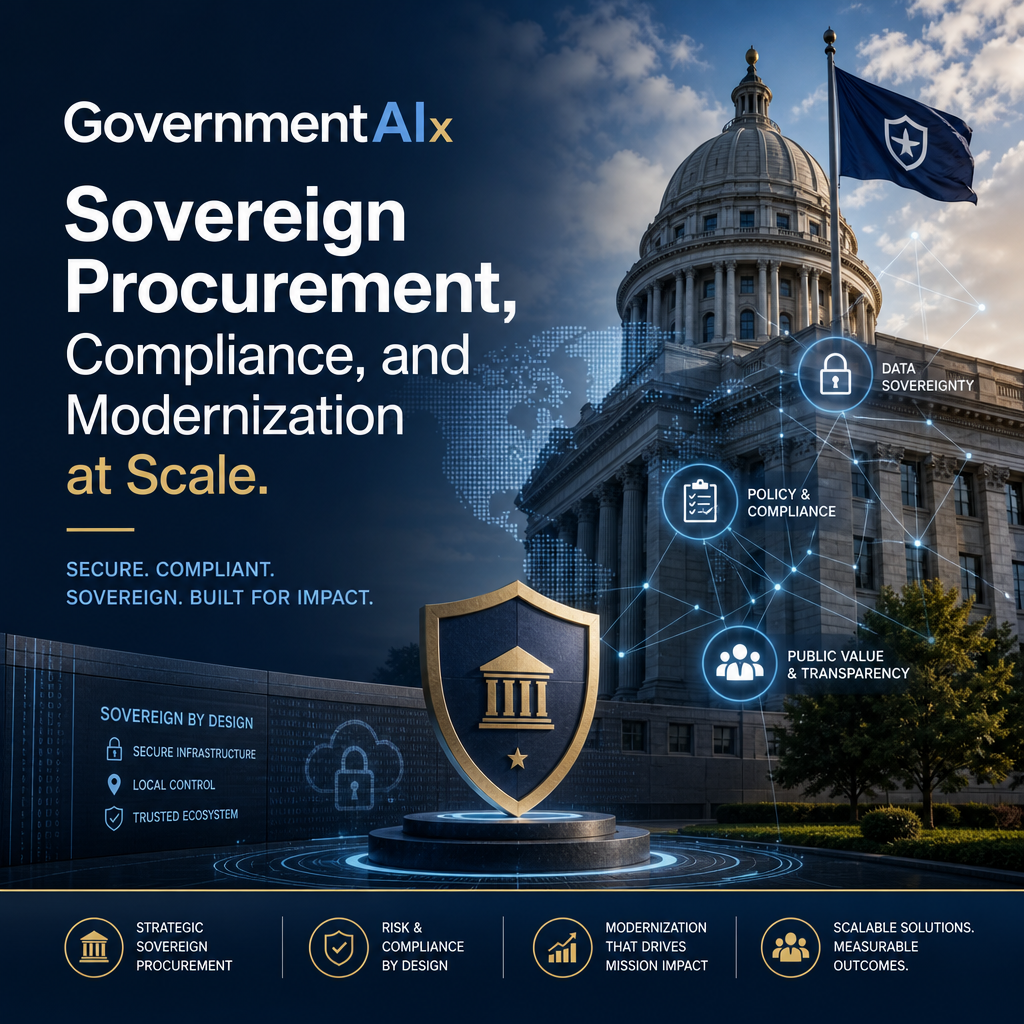
GovernmentAIx: Sovereign Procurement, Compliance, and Modernization at Scale
How GovernmentAIx Powers Sovereign Procurement, Compliance, and Modernization at Scale
Governments are under growing pressure to modernize public services while protecting sensitive information, meeting strict regulatory requirements, and delivering measurable value to citizens. Traditional procurement and technology implementation models often struggle to keep pace with these demands.
GovernmentAIx addresses this challenge by connecting artificial intelligence, sovereign infrastructure, and public-sector governance in a unified approach. The result is a framework that helps agencies procure, deploy, and scale modern technology with greater confidence.
Enabling Sovereign Procurement
Sovereign procurement is about more than purchasing technology from a trusted supplier. It involves ensuring that data, infrastructure, operations, and decision-making remain aligned with national laws and strategic interests.
GovernmentAIx supports this goal by helping public-sector organizations evaluate technology across multiple dimensions, including:
- Data residency and jurisdictional control
- Vendor transparency and accountability
- Cybersecurity and supply-chain risk
- Interoperability with existing systems
- Long-term ownership and operational costs
- Compliance with public procurement standards
This approach allows agencies to assess solutions based on their complete lifecycle rather than focusing only on initial price or short-term functionality.
With AI-assisted procurement workflows, organizations can analyze requirements, compare vendors, identify potential risks, and produce consistent documentation. This can reduce administrative burdens while improving the quality and defensibility of procurement decisions.
Strengthening Compliance by Design
Compliance is often treated as a final review before a system goes live. In complex government environments, that approach creates delays and increases risk. GovernmentAIx embeds compliance into the planning, procurement, deployment, and monitoring stages.
AI can help map systems and processes to applicable regulations, policies, and internal controls. It can also identify documentation gaps, flag unusual activity, and support continuous evidence collection for audits.
A compliance-by-design model can help agencies:
- Establish clear governance responsibilities
- Classify data according to sensitivity and use
- Apply access controls based on roles and need
- Maintain detailed records of system activity
- Monitor changes to models, applications, and infrastructure
- Generate audit-ready reports more efficiently
This does not eliminate the need for human oversight. Instead, it gives compliance teams better tools to focus on judgment, accountability, and high-impact decisions.
Modernizing Legacy Government Systems
Many public institutions rely on systems that were built years or even decades ago. These platforms may still perform essential functions, but they can be difficult to integrate, expensive to maintain, and poorly suited to modern data and service expectations.
GovernmentAIx supports modernization without requiring agencies to replace everything at once. Its approach can include incremental upgrades, application programming interfaces, secure data layers, cloud or hybrid infrastructure, and AI-enabled automation.
Modernization priorities may include:
- Connecting disconnected databases and applications
- Automating repetitive administrative processes
- Improving search and access to government information
- Enhancing citizen-service delivery
- Detecting operational inefficiencies
- Supporting faster, evidence-based decision-making
A phased strategy reduces disruption and allows agencies to demonstrate value through targeted projects before expanding across departments or jurisdictions.
Scaling From Pilots to National Capability
Many government AI initiatives begin as small pilots but struggle to move into production. Common barriers include unclear ownership, fragmented data, insufficient security controls, and a lack of repeatable implementation standards.
GovernmentAIx helps create the foundation for scale by standardizing how AI solutions are evaluated, governed, deployed, and monitored. Reusable architectures and common policy controls make it easier to expand successful initiatives while maintaining consistency.
This is especially important when agencies need to coordinate across regions, ministries, or public-sector partners. A shared framework can reduce duplication and enable secure collaboration without compromising sovereign control.
Building Trust in Public-Sector AI
Public trust is essential to the successful use of artificial intelligence in government. Citizens and public employees need confidence that systems are secure, fair, explainable, and accountable.
GovernmentAIx supports trustworthy adoption through strong governance practices, human oversight, transparent documentation, and measurable performance standards. Agencies can define how systems should be used, when decisions require human review, and how affected individuals can seek clarification or appeal.
Responsible implementation also means recognizing that not every process should be automated. AI should enhance public-sector expertise rather than replace accountability.
A Practical Path to Government Modernization
GovernmentAIx provides a strategic foundation for agencies seeking to modernize procurement, compliance, and technology operations at scale. By combining sovereign control with AI-enabled efficiency, it helps public institutions move faster without compromising security or governance.
The most successful modernization programs will not be defined only by advanced tools. They will be defined by resilient infrastructure, responsible procurement, continuous compliance, and the ability to deliver better outcomes for the public.