

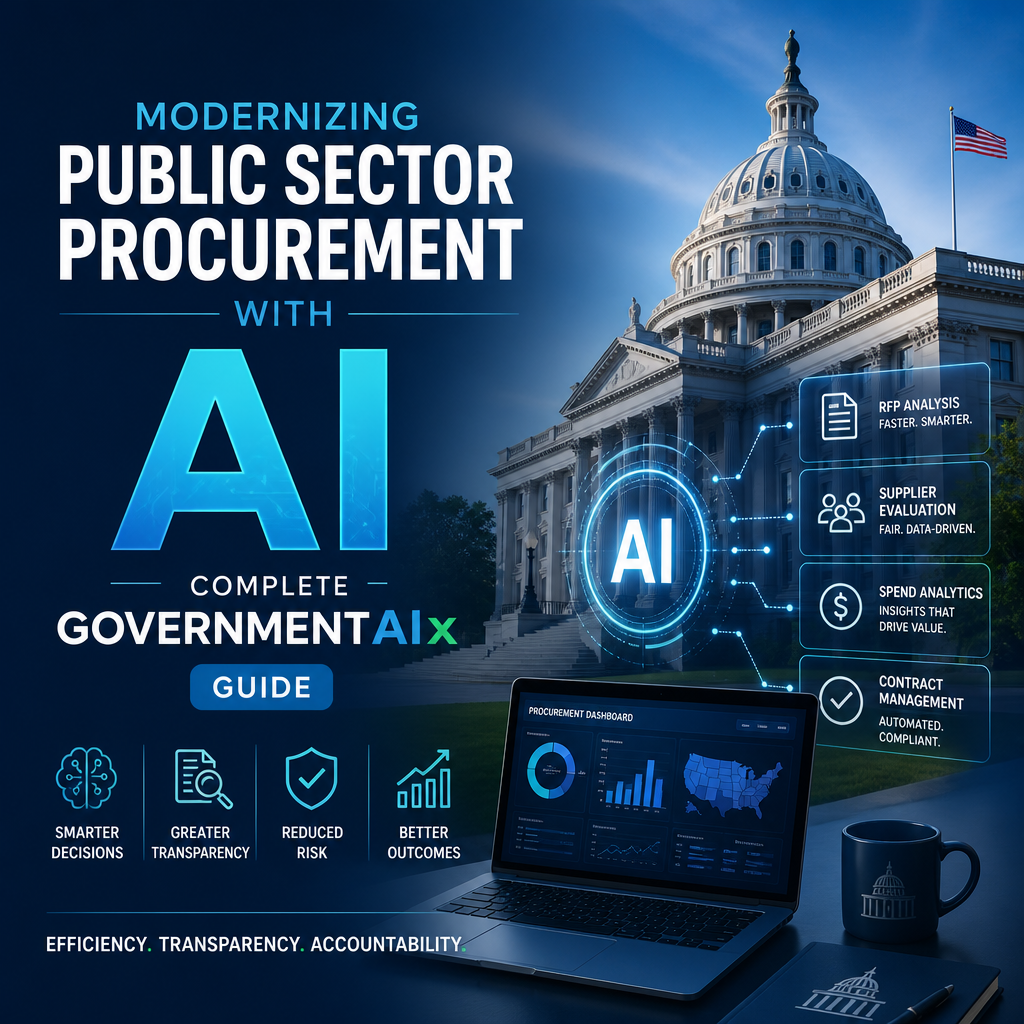
Modernizing Public Sector Procurement with AI: Complete GovernmentAIx Guide
Modernizing Public Sector Procurement with AI: A Complete GovernmentAIx Guide
Public sector procurement is essential to how governments deliver services, build infrastructure, and support communities. Yet many procurement teams still rely on manual processes, disconnected systems, lengthy paperwork, and outdated data.
Artificial intelligence (AI) is changing that. Through automation, predictive analytics, and intelligent decision support, AI can make procurement more efficient, transparent, and responsive. This guide explains how GovernmentAIx can help public agencies modernize procurement while maintaining accountability and public trust.
Why Public Sector Procurement Needs Modernization
Government procurement is often more complex than private-sector purchasing. Agencies must follow strict regulations, manage public funds, evaluate competing vendors, and document decisions for audits and public review.
Common challenges include:
- Slow, paper-heavy approval processes
- Inconsistent vendor information
- Limited visibility into spending
- Difficulty identifying procurement risks
- Repetitive contract and compliance checks
- Delays caused by fragmented systems
These issues can increase costs and make it harder for agencies to respond quickly to changing public needs. Modern procurement technology offers an opportunity to streamline operations without compromising oversight.
How AI Is Transforming Government Procurement
AI can support procurement teams at nearly every stage of the purchasing lifecycle. Rather than replacing public servants, it can handle repetitive work and provide better information for human decision-makers.
Automated Document Processing
Procurement involves large volumes of requests, bids, contracts, invoices, and compliance documents. AI-powered document processing can extract key information from these materials, classify files, and identify missing details.
This reduces data entry and helps staff locate important information more quickly. It also lowers the risk of errors caused by manual processing.
Intelligent Vendor Analysis
AI can analyze vendor records, past performance, pricing, certifications, and risk indicators. This gives procurement officers a more complete view of potential suppliers.
GovernmentAIx can support vendor evaluation by organizing relevant information and highlighting patterns that may require additional review. Human officials remain responsible for final decisions, but they can work with clearer and more consistent evidence.
Predictive Spending and Demand Forecasting
Historical purchasing data can reveal patterns in agency spending and future demand. AI systems can use this information to forecast supply needs, identify seasonal trends, and support better budgeting.
For example, an agency may anticipate increased demand for emergency supplies or technology services. Early insight allows teams to plan purchases, negotiate more effectively, and reduce last-minute procurement.
Improving Transparency and Compliance
Public trust depends on fair, explainable, and well-documented procurement decisions. AI should therefore be implemented with transparency as a central principle.
A responsible GovernmentAIx strategy should include:
- Clear records of how AI-generated recommendations are produced
- Human review for high-impact decisions
- Regular testing for bias and inaccurate outputs
- Secure handling of sensitive data
- Defined accountability for procurement outcomes
AI should support compliance rather than operate as a black box. Procurement professionals must be able to understand, question, and override system recommendations when necessary.
A Practical GovernmentAIx Implementation Roadmap
Modernization does not need to happen all at once. Agencies can begin with focused projects and expand gradually.
1. Identify High-Value Use Cases
Start by reviewing the procurement lifecycle and identifying tasks that are repetitive, time-consuming, or prone to errors. Document processing, invoice matching, spend analysis, and vendor risk monitoring are often good starting points.
2. Prepare Data and Systems
AI depends on accurate, accessible data. Agencies should standardize records, address duplicate entries, and connect relevant procurement systems where possible.
Strong data governance is just as important as the AI technology itself.
3. Establish Governance Policies
Before deployment, define rules for privacy, security, bias monitoring, human oversight, and system access. Agencies should also establish procedures for reviewing AI performance over time.
4. Pilot and Measure Results
A limited pilot allows teams to test the technology in a controlled environment. Useful performance measures may include:
- Reduced processing time
- Lower administrative costs
- Fewer data-entry errors
- Improved contract compliance
- Faster vendor evaluation
Feedback from procurement staff should guide improvements before broader implementation.
The Future of AI-Enabled Procurement
The future of public procurement will likely combine AI-driven insights with experienced human judgment. Advanced systems may help agencies detect fraud, recommend sustainable suppliers, automate routine contract monitoring, and identify opportunities for cooperative purchasing.
However, successful modernization will depend on more than software. Agencies will need staff training, strong leadership, ethical standards, and continuous oversight.
GovernmentAIx provides a framework for approaching this transformation strategically. By combining automation with transparency and accountability, public organizations can build procurement systems that are faster, smarter, and better aligned with community needs.
Conclusion
AI offers public agencies a powerful way to modernize procurement. From automating documents to improving vendor analysis and forecasting demand, intelligent tools can reduce administrative burdens and strengthen decision-making.
The most effective approach is practical and responsible: begin with clear use cases, improve data quality, protect sensitive information, and keep human oversight at the center. With a thoughtful GovernmentAIx strategy, governments can make procurement more efficient while preserving fairness, compliance, and public confidence.