

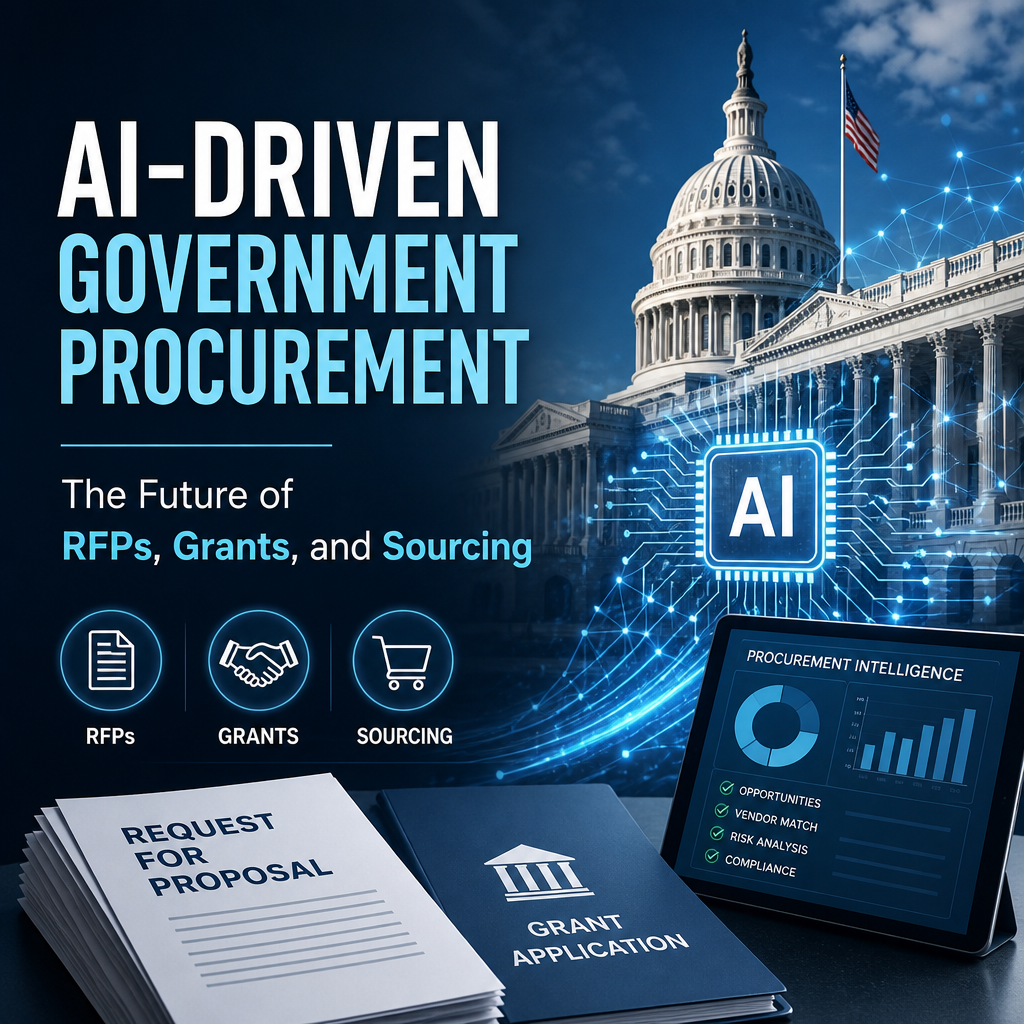
AI-Driven Government Procurement: The Future of RFPs, Grants, and Sourcing
AI-Driven Government Procurement: The Future of RFPs, Grants, and Public Sector Sourcing
Government procurement is entering a new era. Agencies are adopting artificial intelligence to manage complex purchasing processes, improve decision-making, and deliver better value to taxpayers. From drafting requests for proposals (RFPs) to evaluating grant applications, AI-driven government procurement is transforming how public organizations source goods and services.
The shift is not simply about automation. It is about creating procurement systems that are faster, more transparent, and better equipped to handle large volumes of information.
How AI Is Changing Government RFPs
Preparing an RFP can require weeks of research, policy reviews, market analysis, and document drafting. AI tools can support procurement teams by accelerating many of these tasks while maintaining consistency.
For example, AI can help agencies:
- Analyze previous solicitations and contract outcomes
- Identify commonly used requirements and evaluation criteria
- Draft initial RFP language
- Check documents for missing information or conflicting provisions
- Recommend timelines based on project complexity
- Compare proposed requirements with current market conditions
Natural language processing allows AI systems to review large collections of regulations, past contracts, vendor responses, and internal policies. This gives procurement professionals faster access to relevant information and can reduce repetitive administrative work.
However, human oversight remains essential. AI-generated language should be reviewed by legal, technical, and procurement experts before an RFP is released. Public contracts often involve complex compliance obligations that automated systems may misunderstand or overlook.
Smarter Grant Management
Grant programs generate enormous amounts of documentation. Agencies must assess applications, verify eligibility, monitor performance, and report outcomes. AI can make these processes more efficient without eliminating the judgment of grant administrators.
AI-powered systems can help with:
- Sorting applications according to eligibility requirements
- Extracting key information from lengthy proposals
- Identifying missing documents or inconsistent data
- Flagging potential duplicate submissions
- Tracking milestones and spending patterns
- Supporting compliance and reporting activities
By automating routine reviews, grant managers can spend more time evaluating program quality and supporting recipients. AI can also help identify patterns across grant portfolios, such as geographic gaps, recurring delays, or underserved communities.
Care is necessary when using algorithms to rank or screen applicants. Agencies must test systems for bias, document decision criteria, and provide clear processes for human review and appeals.
Improving Public Sector Sourcing
Public sector sourcing involves more than finding the lowest price. Agencies must consider quality, supplier diversity, resilience, sustainability, security, and long-term value. AI can analyze these factors together, helping procurement teams make more informed decisions.
Predictive analytics may help agencies anticipate demand, identify supply chain risks, and determine when to renew or renegotiate contracts. AI can also monitor market data and alert officials to price changes, emerging suppliers, or potential disruptions.
For example, a procurement system might detect that a critical component depends heavily on a single region or supplier. Officials could then explore alternative vendors before a disruption occurs. This type of insight can strengthen public-sector resilience and reduce emergency purchasing.
Benefits of AI-Driven Government Procurement
When implemented responsibly, AI can provide several advantages:
- Greater efficiency: Automated workflows reduce manual processing and paperwork.
- Improved transparency: Consistent data and documented processes make decisions easier to audit.
- Better value: Advanced analysis can reveal pricing patterns and support stronger negotiations.
- Reduced risk: Systems can flag compliance issues, fraud indicators, and supply chain vulnerabilities.
- More strategic work: Procurement professionals can focus on planning, relationships, and oversight.
These benefits are especially valuable for smaller agencies with limited staff and resources.
Challenges Agencies Must Address
AI adoption also introduces significant risks. Poor-quality data can produce unreliable recommendations. Biased historical records may reinforce inequitable outcomes. In addition, vendors may treat algorithms as proprietary systems, making it difficult for agencies to understand how decisions are generated.
Government organizations should establish clear safeguards, including:
- Human approval for consequential decisions
- Regular testing for accuracy and bias
- Secure handling of sensitive procurement data
- Detailed audit trails
- Transparent vendor accountability requirements
- Training for procurement and program staff
Cybersecurity is another major concern. Procurement platforms contain financial, operational, and sometimes confidential information. Strong access controls, encryption, monitoring, and incident response plans are necessary to protect these systems.
The Future of Public Procurement
AI is unlikely to replace procurement professionals. Instead, it will change their responsibilities. Future teams may spend less time entering data and more time managing strategy, interpreting insights, engaging suppliers, and ensuring public accountability.
The most successful agencies will treat AI as a decision-support tool rather than an autonomous authority. They will combine advanced technology with clear policies, skilled employees, ethical standards, and meaningful public oversight.
As agencies continue modernizing RFPs, grants, and sourcing, AI-driven government procurement will become an important foundation for more responsive and effective public services. The goal is not merely to purchase faster. It is to make better decisions, protect public trust, and deliver stronger outcomes for communities.